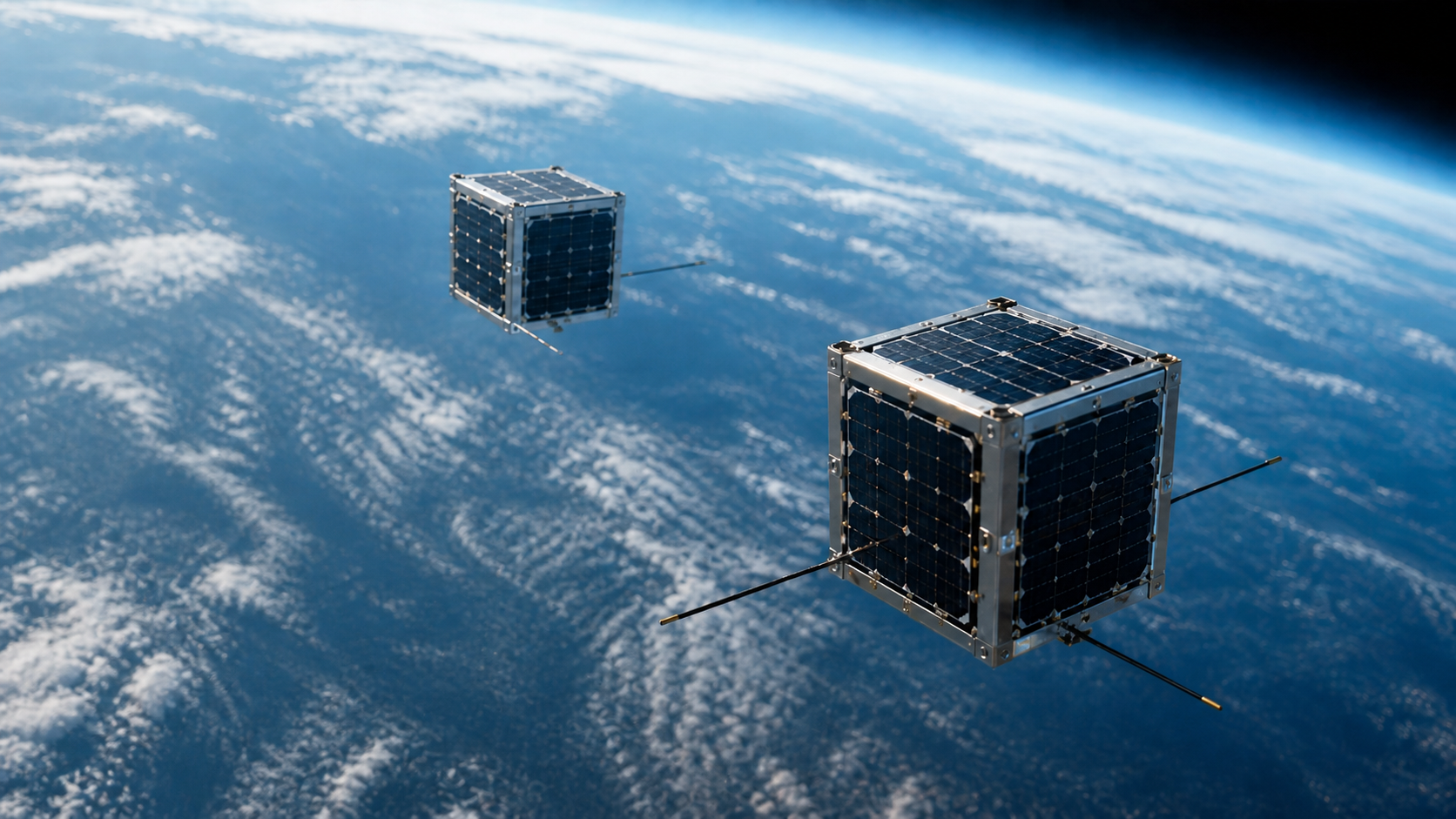
Foxconn launched PEARL-1A and PEARL-1B into low Earth orbit, extending its electronics manufacturing strategy into satellite infrastructure.
Foxconn has successfully launched its second-generation low-Earth-orbit (LEO) satellites, PEARL-1A and PEARL-1B, aboard a SpaceX Falcon 9 rocket from California. Both satellites entered their intended orbits and are planned to undertake on-orbit missions for five years, primarily aimed at verifying payload technologies in communications and space science.
This development is significant not only as a spaceflight milestone but also because Foxconn is principally recognized as a global electronics manufacturer rather than a traditional satellite operator. By sending these experimental satellites into orbit, Foxconn extends its role into a more integrated position within satellite infrastructure, blending manufacturing expertise with communications and space systems.
The immediate goal is not to launch a consumer-facing satellite internet service but to support industrial-scale technology validation. With these two spacecraft in orbit, Foxconn and its research partners gain a crucial platform to test how payload technologies perform in space, assessing aspects such as communication capabilities, satellite-to-satellite interactions, and the influence of the space environment on components.
Foxconn’s deployment of PEARL-1A and PEARL-1B underlines a pivotal move by an electronics manufacturing giant toward participating directly in the satellite communications ecosystem, reflecting broader shifts in connectivity infrastructure planning.
Reuters reported on May 3, 2026, that Foxconn confirmed the satellites’ successful insertion into intended orbits aboard a SpaceX Falcon 9. SpaceX’s CAS500-2 mission manifest lists the PEARL satellites as part of a rideshare deployment facilitated by Exolaunch, illustrating a cost-efficient launch approach where multiple payloads share a single rocket flight.
The PEARL program is steered by Hon Hai Research Institute, tying into ongoing research on LEO communications and non-terrestrial networks (NTN), which are expected to be critical elements in future 6G connectivity frameworks. The LEO satellites are envisioned as complementary infrastructure to terrestrial networks, extending coverage to geographically challenging or underserved areas.
Technical documentation from the Small Satellite Conference describes PEARL-1A and PEARL-1B as 6U XL CubeSats developed with National Central University’s integration. Their payloads encompass inter-satellite links, a Compact Ionospheric Probe, and Perovskite Solar Cells, with Ka-band communications facilitating both space-to-Earth and inter-satellite experiments.
These payloads emphasize technology validation rather than a finished commercial product. Inter-satellite links are fundamental research for dynamic mesh networks in orbit, ionospheric probes improve understanding of radio signal behavior, and advanced solar cells assess energy efficiency and durability in space conditions.
For users and enterprises, the evolution of such satellite infrastructures could eventually translate to enhanced connectivity in remote communities, marine environments, emergency networks, industrial sites, and logistics operations. Such applications depend on advances in technical reliability, standards, regulatory approvals, ground equipment availability, and viable commercial business models.
Foxconn’s entry into the satellite manufacturing and validation arena poses strategic questions about the role of electronics manufacturers in the expanding space infrastructure market. Precision manufacturing, integrated components, and systems engineering are critical to satellite performance, areas where companies like Foxconn hold substantial expertise. This launch exemplifies a convergence of traditional electronics manufacturing with satellite communications emerging as a key connectivity layer.
However, important questions remain unanswered in public records. There is no confirmation of an active commercial satellite service linked directly to PEARL-1A or PEARL-1B, nor details on customer engagements, capacity, pricing, or timeline for deployment to end-users. The clearest verified fact is Foxconn’s successful orbital deployment of these experimental satellites for technology validation.
Going forward, Foxconn’s PEARL program transitions from development and launch phases into operational testing and evaluation in orbit. The principal future milestone will be the public release of mission data, communication performance metrics, and whether experimental results lead to a defined civilian satellite infrastructure offering.