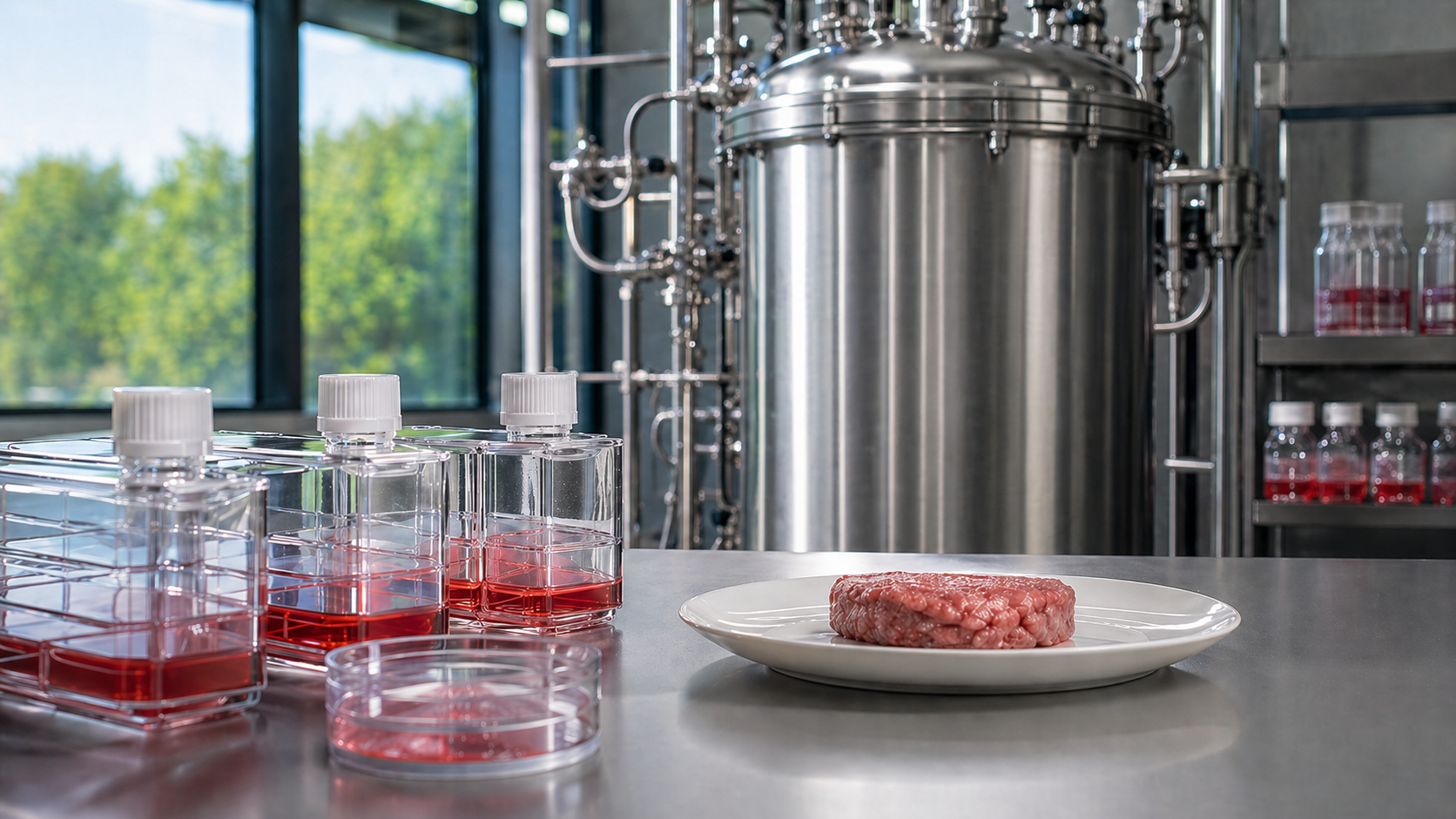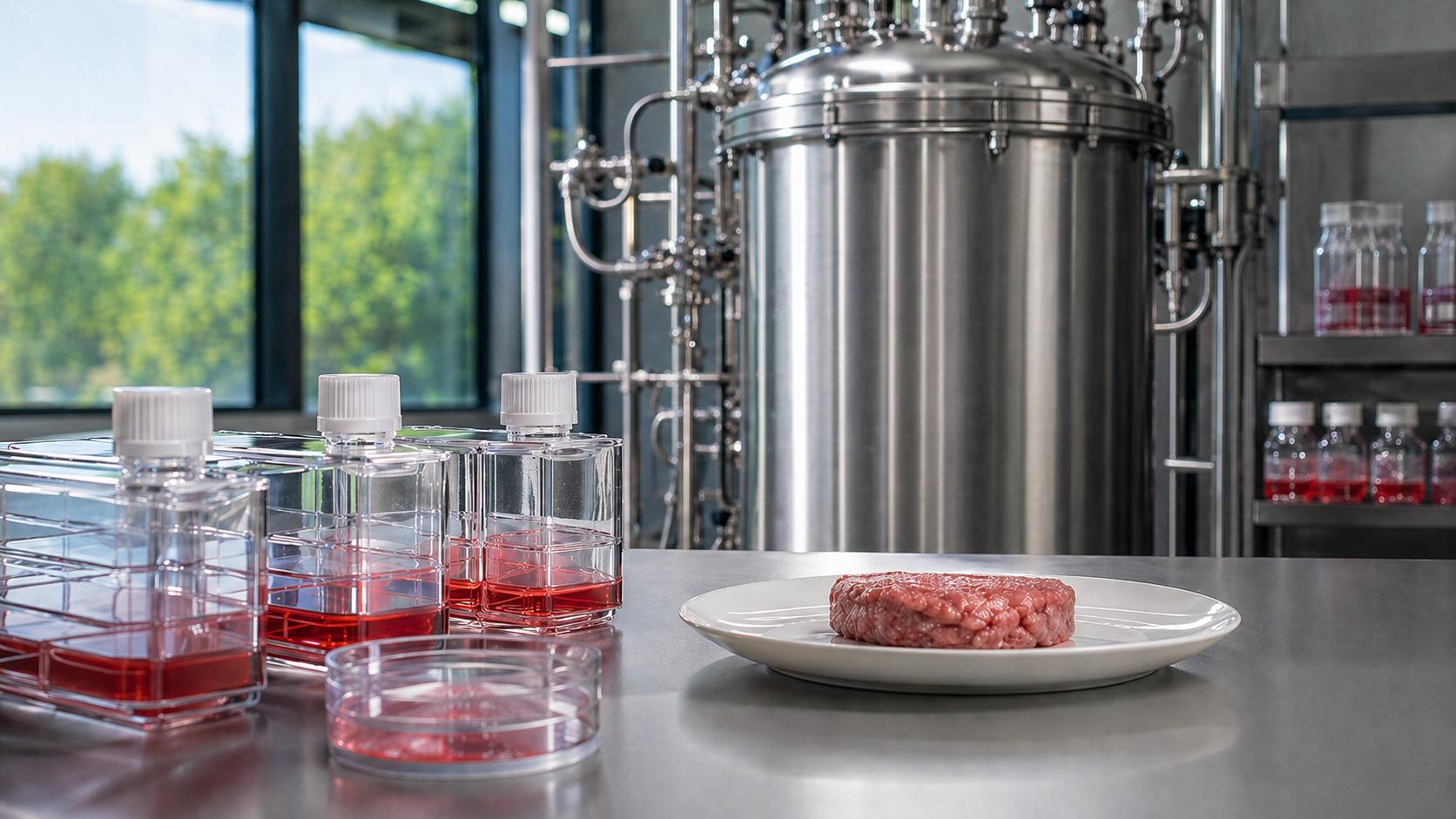
Lab-grown meat begins with a small biological starting point: animal cells. The U.S. Food and Drug Administration describes foods made from cultured animal cells as products created by taking cells from livestock, poultry, seafood, or other animals and growing them in a controlled environment. Manufacturers typically begin with a tissue sample, select and screen cells from that sample, create a cell bank, and then place cells in sealed sterile vessels where they multiply before being guided toward muscle, fat, or connective tissue characteristics.
At first, that sounds like a simple idea: a biopsy, a cell bank, a bioreactor, and then food. But the central question is more difficult. If the process begins with biopsies from animals, how many animals are needed? And if the industry tries to avoid repeated biopsies by using cells that can divide for a very long time, what kind of biological material is the consumer being asked to eat?
That is where the debate moves from food technology into public trust. A 2021 peer-reviewed review, “Immortalizing Cells for Human Consumption,” explains that primary cells can only divide a finite number of times before they enter senescence, meaning they stop dividing. According to that review, using primary cells for cultured meat would require keeping donor herds and regularly acquiring biopsies approved for food production. In other words, if the system relies only on ordinary primary cells, the promise of “one small sample” becomes more complicated. The process may still reduce slaughter, but it does not necessarily remove animals from the production chain.
That technical limitation explains why companies and researchers have looked at immortalized cell lines. These are cells that do not stop dividing in the same way ordinary primary cells do. The same review says immortal cell lines can exhibit infinite divisions and could allow more consistent cultured meat without an ongoing need for animal biopsies. But that answer creates a second and more sensitive question: if the cells are designed, selected, or modified to keep dividing indefinitely, should the public understand the food as ordinary meat, as a novel food, or as a biotechnology product requiring more explicit labeling?
The word “immortalized” is important because it describes a biological change in the behavior of the cell. The review says cell lines can become immortal through spontaneous immortalization, telomerase expression, or methods that bypass cell-cycle checkpoint pathways such as p53, p16, or Rb. It also notes that these changes can occur naturally or be directed by genetic manipulation. That means cultivated meat is not one single biological category. Some systems may use non-engineered cells. Some may use spontaneously immortalized cells. Others may rely on genetic engineering to improve proliferation or differentiation.
This is where the consumer question becomes direct: is the public eating genetically modified food, mutated cells, or something else? The careful answer is that it depends on the cell line and the production method. “Transgenic” is a narrower term usually associated with inserting genetic material, while “genetically modified” or “genetically engineered” can describe broader forms of intentional genetic alteration. Spontaneously immortalized cells may not be treated the same way as genetically modified cells in some regulatory systems, but the review warns that spontaneous immortalization can involve additional mutations that may alter cellular behavior in unpredictable ways.
That does not mean lab-grown meat should be described as automatically harmful. It does mean that the safety question is not trivial. The same review states that one common consumer concern is the safety of ingesting cell lines, and says that immortalized cultured-meat cell lines may contain expressed oncogenes and would need confirmation that food products made with those cells do not have tumorigenicity. It also says that genetically engineered animal cells require further investigation and that future products made from immortalized animal cells expressing oncogenes, whether through spontaneous immortalization or genetic engineering, remain a knowledge gap.
There is a crucial distinction here. The responsible concern is not that eating a mutated animal cell will automatically mutate the person who eats it. That claim would go beyond the evidence. The better question is whether changes in the cell line could alter proteins, metabolites, allergens, or other characteristics of the final food in ways that must be tested before regular human consumption. The review also says cell lines need monitoring for contamination and genetic drift, because mutations can build up over time and eventually change cell traits.
In the United States, the FDA’s regulatory description reflects that complexity. Its pre-market consultation process evaluates the production process, cultured cell material, cell lines, cell banks, manufacturing controls, and all components and inputs. The FDA also says it oversees cell collection, cell banks, growth, and differentiation, while USDA-FSIS oversees further production and labeling for certain livestock and poultry products after harvest. That matters because, at least under the U.S. framework, the safety review is not only about the final product; it is about the biological pathway that created it.
WHO and FAO have framed the issue in similar terms. Their 2023 publication on food-safety aspects of cell-based food says cell-based food production raises urgent consumer questions about food safety, examines the technologies used to produce these foods, identifies potential food-safety hazards, and reviews regulatory frameworks in different countries. This does not declare cultivated meat unsafe. It says the field requires structured hazard identification and regulatory attention.
In this context, some countries and states have decided to prohibit or restrict cultivated meat. Italy’s parliament gave final approval in November 2023 to a law banning the use, sale, import, and export of food and feed “from cell cultures or tissue derived from vertebrate animals,” according to Reuters. In the United States, the National Conference of State Legislatures reported in February 2026 that Florida, Alabama, Texas, and Montana had adopted measures barring the sale or distribution of meat produced from lab-grown animal cells, while other states had focused on labeling, misbranding, public procurement, or regulatory study.
For consumers, the issue is not simply whether the product is “real meat” or “fake meat.” The deeper issue is whether the label explains the biological route. Was the product made from primary cells taken through repeated biopsies? Was it made from immortalized cells? Were those cells spontaneously immortalized or genetically engineered? Were oncogenes, telomerase, or checkpoint-bypass mechanisms involved? Has the final food been tested for genetic stability, contamination, altered proteins, allergenicity, and residual culture inputs?
Those questions do not require panic. They require transparency. Cultivated meat may be presented as a way to reduce conventional slaughter, but if ordinary primary cells do not divide long enough, the system may still require donor animals and repeated cell collection. If immortalized cells are used instead, the animal-dependence problem may be reduced, but the public inherits a different question: what does it mean to eat tissue produced from cells selected or modified to keep dividing indefinitely?
The debate over lab-grown meat is therefore not only about technology. It is about the biological meaning of food. Conventional meat comes from the full life of an animal. Cultivated meat begins with cells separated from that life and maintained in a controlled system. That shift may be acceptable to some consumers and unacceptable to others. But it should not be hidden behind vague language.